
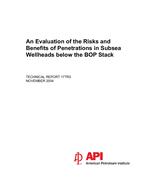
API TR 17TR3 PDF
Provides an evaluation of the risks and benefits of allowing penetrations in subsea wellheads below the blowout preventer (BOP) stack so annuli other than the production tubing (commonly referred to as the "A" annulus) could be monitored.
Current industry standards (API Spec 17D and ISO 13628-4) for the design of subsea wellheads prohibit penetrations below the (BOP) stack. In contrast, Minerals Management Service (MMS) regulations (30 CFR 250.517) require that all annuli be monitored for sustained casing pressure and that every occurrence of sustained casing pressure be reported immediately.
The study concludes that the risks outweigh the benefits since the risk of maintaining the pressure barrier using a wellhead with penetrations is approximately two-and a-half times that of a system without penetrations. The scope of this study is limited to completed subsea wells in the Gulf of Mexico (GOM). The risks were evaluated using fault tree analysisfor three systems:
-wellhead system without penetrations
-wellhead system with one penetration and
-wellhead system with two penetrations.
More Standards PDF
API RP 17Q:2010
$74.00 $149.00

API Std 619
$120.00 $241.00
API RP 2MOP (R2021)
$135.00 $271.00
API TR 934-D:2010
$75.00 $150.00