
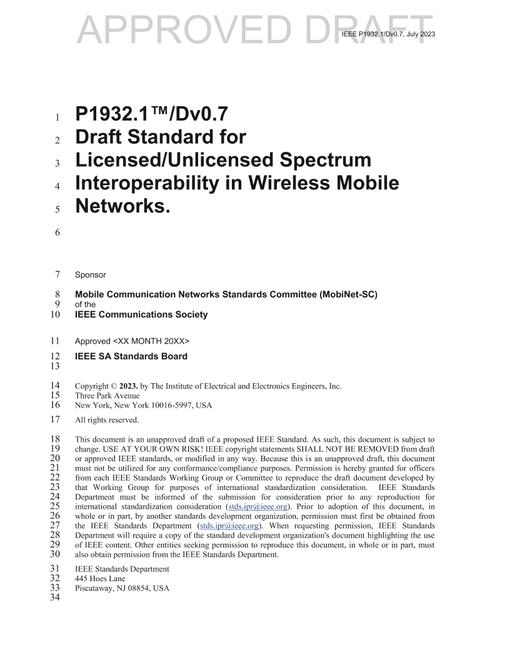
IEEE 1932.1-2024 PDF
This standard defines a mechanism for communications among entities operating in licensed and unlicensed spectrum. The mechanism includes interoperation among media access control/physical layer (MAC/PHY) protocols designed for unlicensed and licensed spectrum operations and a controller for coordination among communicating entities.
New IEEE Standard - Active. The proliferation of connected users and downloaded applications has driven the development of a new paradigm in wireless mobile networks. Additional air interfaces operating in the unlicensed spectrum serving as supplementary downlinks (SDL) and enhancing end-user throughput are utilized by this paradigm. However, integrating these interfaces into licensed base stations can be challenging, as they are distributed across various domains. WiFi is a key technology for increasing capacity through the user plane interface. Traffic is buffered in WiFi when unlicensed channels become unavailable, and transmissions resume once new radio slots are free.
To meet the strict round-time delay requirements of fifth generation (5G) networks, a new virtual controller that resides at the mobile edge cloud is defined in this standard. The multi-connectivity model and traffic sharing between licensed and unlicensed interfaces are coordinated by the controller based on the real-time availability of unlicensed channels for specific user equipment.Two schemes are presented for managing multi-connectivity modes: distributed and centralized. In the distributed scheme, traffic forwarding and steering between distributed radio interfaces across domain sites is managed by the controller. In the centralized scheme, various radio interfaces are co‑located in the same base station, and traffic steering is managed by the controller through a new unified 5G media access control (MAC) design. Traffic sharing between different interfaces is ensured by the controller, given that access to operator-deployed WiFis or any other customer WiFi using separate service level agreements (SLAs) is provided by operators. Multi-connectivity modes imply the provision of efficient new services that may require measuring airtime for each interface and changes to user plane topology.
More Standards PDF
IEC 60601-2-4 Ed. 3.0 b:2010
$208.00 $417.00
IEC 62537 Ed. 1.0 b:2010
$117.00 $234.00
IEC 60519-1 Ed. 4.0 b:2010
$115.00 $230.00
IEEE 1685-2009
$129.00 $258.00