
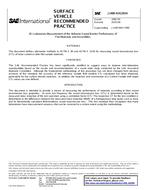
This SAE Recommended Practice presents a test procedure for determining the airborne sound insulation performance of materials and composite layers of materials commonly found in mobility, industrial and commercial products under conditions of representative size and sound incidence so as to allow better correlation with in-use sound insulator performance. The frequency range of interest is typically 125 to 8000 Hz 1/3 octave band center frequencies.
This test method is designed for testing flat samples, although in some applications the methodology can be extended to evaluate formed parts, pass-throughs, or other assemblies to determine their acoustical properties. For non-flat parts or assemblies where transmitted sound varies strongly across the test sample surface, a more appropriate methodology would be ASTM E90 (with a reverberant receiving chamber) or ASTM E 2249 (intensity method with an anechoic or hemianechoic receiving chamber).
This test method is designed for testing flat samples, although in some applications the methodology can be extended to evaluate formed parts, pass-throughs, or other assemblies to determine their acoustical properties. For non-flat parts or assemblies where transmitted sound varies strongly across the test sample surface, a more appropriate methodology would be ASTM E90 (with a reverberant receiving chamber) or ASTM E 2249 (intensity method with an anechoic or hemianechoic receiving chamber).
SAE J1400_201008 History
SAE J1400_202310
$60.00 $120.00
SAE J1400_201707
$58.00 $116.00
SAE J1400_201008
$47.00 $94.00
SAE J1400_201008
$47.00 $94.00
More Standards PDF
SAE AS7974/5
$22.00 $44.00
SAE AS6040
$69.00 $139.00
SAE MA4623
$61.00 $122.00
SAE AMS5075F
$28.00 $56.00